

Page 1 of 1
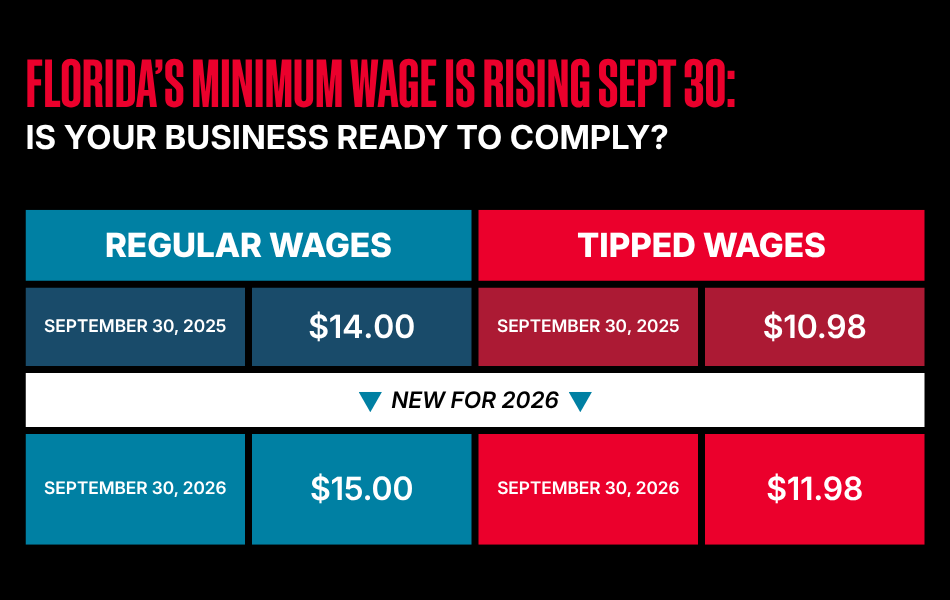
Florida employers need to prepare for a minimum wage hike to $15 an hour on September 30th. And if you have tipped employees, you’ll need to pay them at least $11.98. This is the last of the annual increases voters approved in 2020. We’ll tell you what’s changing and the steps you should consider taking now to comply.
Here’s What’s New
In November 2020, Florida voters approved a constitutional amendment that gradually increases the state’s minimum wage to $15 per hour for most non-exempt employees by 2026. Notably, the tip credit for Florida hospitality employers that claim it will remain $3.02 per hour, which means you’ll have to cover the extra dollar for tipped employees, too.
The state’s hourly minimum wage increased from $8.65 to $10 in 2021 and has been rising by $1.00 each year on September 30. This September brings the final increase and the following minimum wage requirements:
Potential Penalties
All Florida employers are required to comply with the new minimum wage requirement. If an employee is not paid at the required rate, they could be entitled to recover back wages plus damages and attorneys’ fees and costs under the state’s wage theft law and the Florida Minimum Wage Act. In addition, employers found liable for intentionally violating minimum wage requirements could be subject to a $1,000 fine per violation.
What Should You Do Now?
Here’s what you should do to prepare for the new wage rate and stay compliant:
1. Make sure payroll is set up to capture the new minimum wage ahead of the September 30th effective date.
2. Update the required minimum wage poster to reflect the new rate. As a reminder, all employers are required to post federal and Florida employment law posters where they can be easily seen by employees. If you need a copy of the new notices, please reach out to our office.
3. Be aware of local wage theft ordinances. Several counties around the state have their own wage theft ordinances that provide for more relief than the state law. For example, if an employee files a wage theft claim in Miami-Dade County through the county’s Wage Theft Program, employers face paying three times the amount of wages owed to an employee.
4. Check compliance with tip credits and tip pools. Employers that take a tip credit must ensure that tipped employees still receive at least the new minimum wage when tips are included. If your payroll system or tip pool does not properly account for the increase, you could inadvertently invalidate the tip credit and violate wage laws. Review your pay practices and any tip-sharing arrangements to confirm they remain compliant under the new rate.
5. Plan for what comes after 2026. The voter-approved phased increases end with this one, but Florida’s minimum wage won’t stay at $15 indefinitely. The Department of Commerce could make annual inflation adjustments, and we expect minimum wage hikes to make their way onto the ballot again in the near future. Employers should track these developments for both compliance and budgeting purposes.